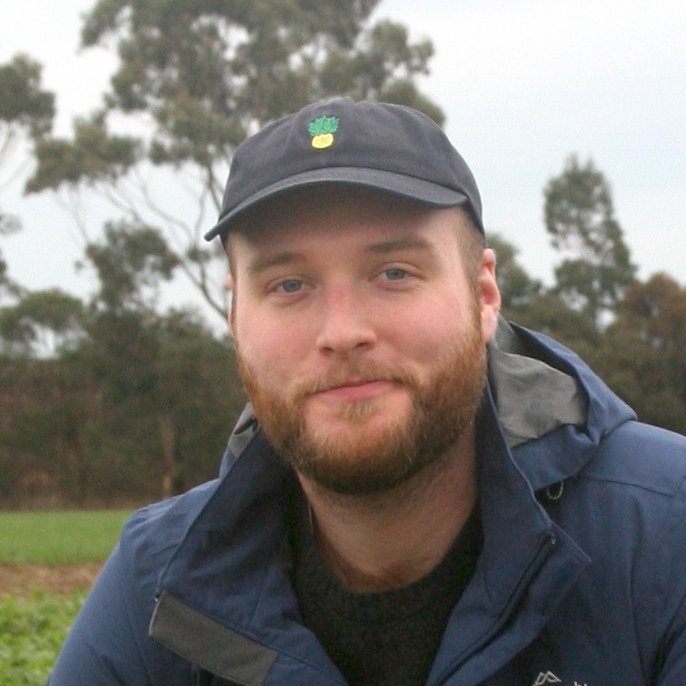
I graduated a couple of weeks ago! Now the proud owner of a (legitimate) bit of paper that says I have a degree, and the legal right to put “B.Sc.” after my name.
My Dad and I, taking the concept of a “graduation photo” very seriously.
Yep, I’ve got a Bachelor of Science degree, majoring in Genetics (and also Biochemistry & Molecular Biology, but you’ll never see it on my transcript)! I’m starting a Master of Science (Genetics) at the University of Melbourne and the Bio21 Molecular Science and Biotechnology Institute in February! My research project, which I’ll probably be discussing a little bit of detail over on the Young Australian Skeptics blog in the coming months, is all about functionally analysing an unknown gene family in Drosophila melanogaster that may have links to insecticide resistance and metabolic arms-races against bacteria and fungi!
A little under 12 hours ago, the Young Australian Skeptics blog relaunched with a gorgeous new website, new articles, and a new writing team, all under the direction of yours truly, its new head editor! There’s a dedicated podcast page now, which is fantastic, as well as a page about the YAS’s book, which was also sorely needed. I spent over six feverish months working on recreating the site with my good friends Catherine and Joel, and it’s great to see the site finally out there for the Internet public to enjoy!
Here’s the spiel from the About page:
The Young Australian Skeptics is a group blog run by a team of young science communicators, students and professionals, focused on the crossroads of science and critical thinking with religion, education, technology, politics, medicine, law and wider society — in essence, scientific skepticism and its cultural impact.
With opinion pieces, educational articles, news, satire, entertainment and personal writing, we aim to challenge conventional thinking about the place for young people in serious and substantive online conversation and provide a place where young voices can be heard and their perspectives discussed. All in an Australian context, of course.
The Young Australian Skeptics was founded by Elliot Birch in 2008 as an experimental community-style blog, and was relaunched as its current incarnation in 2012 by Jack Scanlan. It currently has a 16-member writing team, 4 of whom also serve as editors and site administrators. Other writers occasionally contribute guest articles.
Of course, my work isn’t over. As head editor, I’ll be constantly overseeing the site, which includes checking new articles (at least until the writers learn their way around the backend of the blog) and comment moderation. I’ll also have to write articles myself! Sadly, this means I’ll have very little time to write for ol’ Homologous Legs - at least with my “usual” ID/evolution stuff, which will probably be moving to the YAS, considering it’s all very relevant to science communication and skepticism. Anything I write here will probably be a bit more personal-ish, perhaps? Non-science related? I’ve had a few interesting thoughts about the concept of gender recently that I’ll need to get out eventually. Stuff like that, you know.
S0, this blog’s going to be quiet-ish for a while. But it’s not like it was super-busy recently anyway, right?
I must apologise for my absence – I’ve been busy for a number of months now, and to be quite honest, the intelligent design community has been rather lackluster in its pronouncements of late…
What have I been busy with? Well, I’m in the middle of my final undergraduate exam period ever (my Genetic Analysis exam was today, so I’ve got vectors, cDNA libraries and live cell tracking on the brain), which should be over by the middle of the month. The other major thing in my life at the moment is the Young Australian Skeptics blog relaunch, which is probably going to happen very soon. Look, we even have new business cards and everything!
Seriously, all this work has got my brain fried. I’m trying to set the YAS up as the go-to place for young skeptical and scientific-informed opinion in Australia (if not the word, but that might be pushing it, you think?), and it’s hard. Plus, add in the weekly podcasting…
Hopefully I’ll be posting semi-regularly on ol’ HL again soon. But that won’t be for a while, so… Why do you just keep an eye on youngausskeptics.com? You never know what might appear…
I said I’d tell you when it was published – and it’s been published! Somewhat surprisingly, I was asked by my friend Khalil to write up my thoughts on the whole ENCODE project/junk DNA/the-human-genome-is-80%-functional fiasco for the Student Voices blog, but from the perspective of what intelligent design proponents were taking from it all. If you’ve been following pro-ID blogs Evolution News and Views and Uncommon Descent lately, there’s been little end to the victorious proclamations – because, as we all know, the more functional the genome is, the more likely ID is to be true, right?
Uh, yeah. Right. Sure. This is one of the issues I discuss in my Nature Education post (and don’t forget that I’ve discussed it on Homologous Legs before too), along with some other things.
Here’s a taste to get you in the mood:
Where to start? It’s unlikely that you’ve missed any of the extensive media coverage the Encyclopedia of DNA Elements (ENCODE) project has received over the past two weeks, after the international team of scientists responsible published 30 papers in high-profile journals detailing their efforts in mapping the activity of the human genome in over 100 cell types. Nearly every newspaper, online news site and vaguely science-y blog has written something about the accomplishment, with most focusing on what has become, unarguably, ENCODE’s most controversial “finding”: that over 80% of the genome is functional.
A good proportion of the biology community hit back at the claim, with the blogs of biochemist Larry Moran and evolutionary geneticist T. Ryan Gregory providing some of the more comprehensive critiques (which are spread across multiple posts on their blogs – have a look through their archives if you’re interested in the details). The consensus amongst the critics is that the leaders of ENCODE have a very loose definition of “functional”, under which it is likely most possible DNA sequences will fall, including those uncontroversially deemed “junk DNA”, simply due to the noise and imprecision inherent in various biological processes like transcription. Somecritics have even gone so far as to propose the Random Genome Project, a null hypothesis test for the “80% functional” claim essentially based around the question “What proportion of a randomly generated genome, on average, would be assigned function based on ENCODE’s criteria?” If the answer turned out to be around the 60-80% mark, it would cast serious doubts on the claim that most of our genome is functional.
I have good reason to think that there might be a response to this piece forthcoming from ENV in the next few days – like always, I’ll keep you all posted…
It’s now officially a holiday period for me (for some curious reason my university is giving everyone a two-week mid-semester break – but no one’s complaining), but I’m still busy as hell with multiple projects, including coursework, the YAS relaunch, the podcast and just generally trying not to go insane. So! Here are some more interesting/relevant things I’ve stumbled across in the past few days.
Standford University has a free, online writing course through Coursera called “Writing in the Sciences” starting on the 24th of September! It’s free! And online! And seems pretty cool! I’ve signed up (not sure how much time I’ll be able to devote to it, but we’ll see) and you should too, if you’re interested in improving your science writing skills – there’s always more to learn.
Speaking of science writing, Ed Yong has a great post up on his fabulous blog Not Exactly Rocket Science about “photosynthetic” aphids and the dream of photosynthetic humans. I previously touched this topic on Episode 58 of The Pseudo Scientists, but Ed goes into a bit more detail than I did. Plus, he’s a professional. Always go with the professional.
Speaking of The Pseudo Scientists, Episode 59 was released on Sunday! Belinda, Tom, I and special guest Ted Janet talk about the ENCODE project and junk DNA, nano-ink, transgenic camels and Ted’s time at The Amaz!ng Meeting 2012. If you’ve never listened to the show before, uh, make sure you do, I guess? I put a lot of work into it, so I’d be nice to have people listen. You know, if you want. It’s your time, after all. (Oh, what’s this, a handy link to the iTunes page, where you can subscribe to the podcast? Dear me.)
(Speaking of ENCODE, I have a new post for Nature Education’s Student Voices on ENCODE, junk DNA and intelligent design creationism coming out in the next couple of days – I’ll draw your attention to it when it goes up.)
Speaking of the Young Australian Skeptics, we’re having a sale for our book, the YAS’s Skeptical Blog Anthology (featuring yours truly, but also featuring Phil Plait, Evan Bernstein, Daniel Loxton, Barbara Drescher and more!), at the moment – enter the code PIRATA at checkout to receive 15% off! Offer closes September 21st, so hurry, I guess? It’s truly a great book, and sales help support both the YAS blog and the podcast, as well as our failing egos.
And because this wouldn’t be a Homologous Legs post without a reference to good ol’ St. Vincent, here’s a video from the first date on St. Vincent and David Byrne’s Love This Giant tour. You do want to see Annie Clark and David Byrne play the theramin together, don’t you? Thought so.
You can watch more of the videos from that show here! (I know, it’s Pitchfork, but what’cha gonna do?)
Whoa! Haven’t seen you guys for a while! There’s a good reason for this – it’s my last undergraduate semester of uni before I kick off my Master, and my coursework has completely inexplicably increased dramatically. There are assignments and tests flying at me from all four subjects I’m taking, it’s crazy. Add in my weekly podcast commitment, the relaunch of the Young Australian Skeptics blog and my newfound penchant for caring about my fitness, and there’s little time for some good ol’ Homologous Legs blogging. Very sorry.
But I do have some quick things to leave you! One is the music video for “Who”, the first track off the new St. Vincent/David Byrne collab. album Love This Giant, which I think you’ll find both delightful and deliciously strange. The full album is out September 11th and you can preorder it here, but if you want to listen before you buy (a wise and enjoyable thing to do), NPR is streamingLove This Giant in its entirety for free! Good on them.
Another is the 57th episode of The Pseudo Scientists podcast, which came out last Friday. Sadly I was too busy to put up a post here about it, as I know some of you like to listen to the show through the audio player, but you can listen to it on what would have been a very similar post on the Young Australian Skeptics website (there’s an audio player there too). Rachael, Belinda and Tom go without me this week, talking about sperm, the life of Neil Armstrong and some cosmology, while Ted interviews – wait for it – freakin’ Eugenie Scott from the National Center for Science Education, making it her fourth appearance on the show! Wow. That’s a lot of appearances. The next episode (featuring yours truly!) will be out this Friday – I’ll try and put a proper post up if I can.
Lastly, two of my favourite bloggers/academics/people-related-to-biology, philosopher of science John Wilkins and biochemist Larry Moran, are having a discussion/debate/heated argument over the relationship between science and philosophy. Here’s the latest post on methodological naturalism from Larry – if that interests you, have a read of some of the earlier posts.
Well, that’s all I have time for at the moment. Hopefully I should be back blogging here regularly, but we’ll see if my schedule allows it…
In this episode of The Pseudo Scientists, the official podcast of the Young Australian Skeptics, Belinda, Tom, Rachael and I wonder about the feasibility of DNA-based information storage, look at a new breakthrough in the development of a male reproductive pill and touch on an update to the Kinesio Tape story from Episode 51. Plus, Ted interviews James Randi, living skeptical legend, magician and founder of the James Randi Educational Foundation.
(Note: The current President of the JREF is DJ Grothe, not James Randi as we say multiple times throughout the episode. We apologise unreservedly to the distress we may have caused DJ and his family, and are willing to pay any damages incurred.)
You can find out more about the James Randi Educational Foundation at their website.
If you have feedback for the show, get in touch via our Contact page or send us an email: youngausskeptics(at)gmail(dot)com.
To support the show (and get a great book, but that’s secondary, right?) you can purchase the Young Australian Skeptics’s Skeptical Blog Anthology – available paperback or ebook!
What are you waiting for? Listen in the audio player above, subscribe via iTunes or Libsyn RSS, become a fan on Facebook, and follow the Young Australian Skeptics on Twitter.
State the negative to find out about the positive – that’s the method behind the Antiview project, run by Australian journalist Max Opray. It’s a fascinating series of interviews with priests, sportspeople, futurists, writers, and more, and I was lucky enough to be asked by Max to be a part of it. He posed some interesting negatively-framed questions… You want to know how I answered them, right?
Here’s a taste:
What don’t you enjoy about science?
Real science, good science, proper science, tends to take a long time. I suppose I wish I could push a button and instantly have all the data I’m looking for and not have to go through near-endless cycles of putting small volumes of colourless liquid into small plastic tubes (which is what my field – molecular genetics – tends to devolve into sometimes).
The waiting is hard, the patience is hard. When you’re truly passionate about a question about the natural world, it eats away at you – and every moment you don’t have the answer can be a painful one.
This is all very exciting – the Young Australian Skeptics blog is being relaunched in late August, with your truly at the helm as Head Editor. With a new writing team, a new design and a new focus, we’re looking to breathe new life into the contributions of young people into the online skeptical movement.
In the near future, this blog will endeavour to fill an important niche in communicating scientific ideas, critical thinking and engagement with social and political issues relating to science, religion and education: presenting the views of young people, a demographic currently underrepresented in serious online conversations.
We’re aiming to strike a healthy mix of opinion, news, science communication pieces, personal writing and entertainment – and we’ll certainly have the team to do it! From high school students to young professionals, the new writing team will be filled with people from diverse backgrounds and with unique perspectives on a wide range of issues.
By fostering discussion, communication and debate around science, skepticism, religion, critical thinking and their impact on Australian society and the rest of the world, the Young Australian Skeptics will bring the next generation to the foreground.
Homologous Legs is the personal blog of Jack Scanlan, an Australian science communicator and biology student.
Topics of interest here include the intelligent design/evolution "war", biology, philosophy, religion, music, and mostly coherent thoughts from a scattered brain.
Recent Comments